
Call Us
+1 801 346 2782
An SEO audit is a structured evaluation of the factors affecting a website's ability to rank, attract qualified traffic, and convert search visibility into business results. At Utah SEO Sync, our SEO audits are designed for the modern search environment. We review traditional technical and on-page SEO, but we also evaluate local search, content quality, authority, Answer Engine Optimization (AEO), Generative Engine Optimization (GEO), and AI Search Visibility.
The result is not a generic automated checklist. We organize findings by priority, business impact, and implementation effort so Utah businesses can understand what is limiting performance and what should be addressed first.

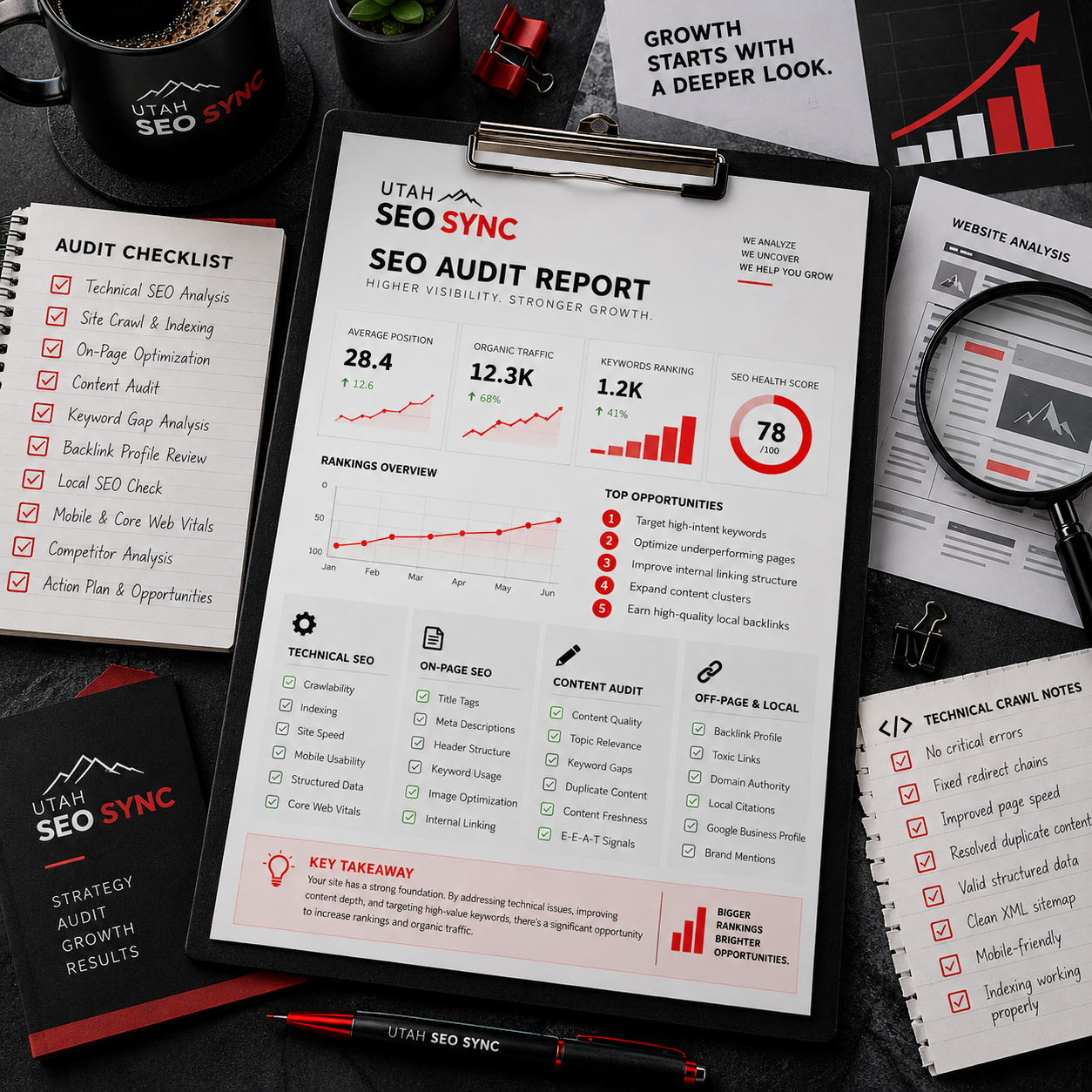
An SEO audit examines how search engines crawl, index, interpret, and evaluate a website. It also reviews whether the site is targeting the right searches, whether content satisfies user intent, whether the website has enough authority to compete, and whether local and AI search systems can clearly understand the business.
A useful audit separates critical issues from lower-impact improvements — and explains the recommended sequence.
Utah SEO Sync provides SEO-focused audits designed around today's search ecosystem. We connect technical SEO, content, local visibility, authority, and AI search rather than evaluating each area in isolation. The goal is to give you a practical roadmap for improving organic performance, not just a score.
Explore our related services to build a complete search strategy: SEO Services, On-Page SEO, Off-Page SEO, Local SEO, Technical SEO, Content Marketing, and AI Search Visibility.
Our audit framework covers ten connected areas — from technical foundations to AI search visibility — so nothing that affects your organic performance is left unexamined.
Crawlability, indexability, XML sitemaps, robots directives, canonical tags, redirects, broken links, duplicate URLs, status codes, site architecture, mobile usability, page experience, Core Web Vitals, HTTPS, and structured data.
Title tags, meta descriptions, heading structure, keyword targeting, search intent, topical depth, content quality, internal links, images, URLs, CTAs, and potential keyword cannibalization.
Quality, relevance, diversity, and overall health of external links. We compare authority with competitors, identify lost-link opportunities, and look for suspicious or low-value patterns.
Google Business Profile alignment, categories, services, reviews, citations, NAP consistency, location pages, local schema, map visibility, and local competitors.
FAQs, definitions, question-based headings, concise answer formats, schema opportunities, conversational search intent, and whether service information is easily extractable by answer-driven systems.
Entity clarity, topical authority, brand consistency, structured information, expert content, third-party mentions, citations, and the degree to which the site provides trustworthy, summary-ready material.
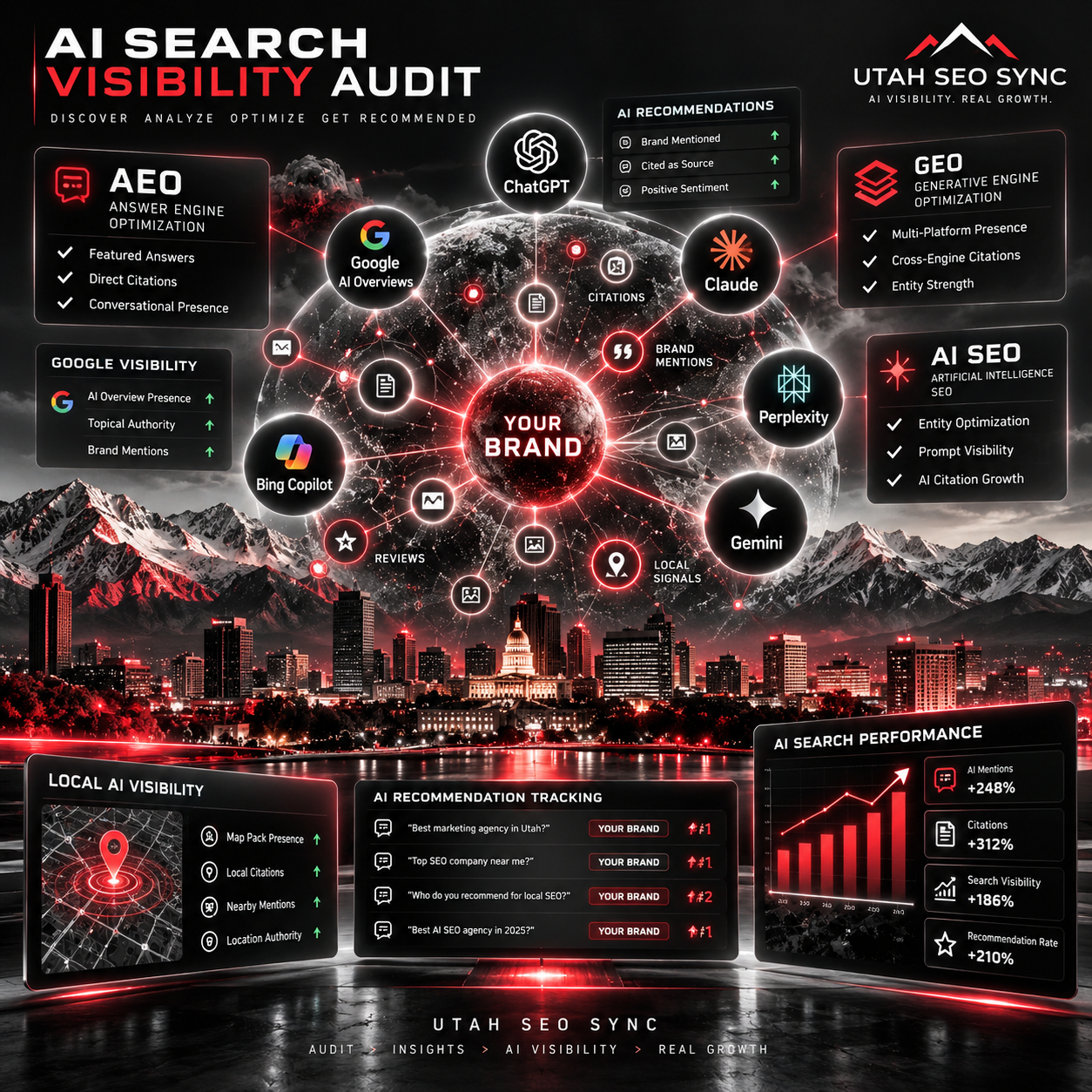
Brand mentions and recommendation visibility, competitor share of voice, AI referral traffic, entity consistency, citation sources, content formats, and local AI recommendation signals.
Rankings, content depth, site structure, backlinks, local presence, keyword coverage, and search features — benchmarked against the businesses already winning in search.
Pages missing from the index, low-value pages unnecessarily indexed, redirect chains, crawl traps, duplicate parameters, and other issues that waste crawl attention or create conflicting signals.
Click depth, orphan pages, internal anchor text, navigation, and how authority flows through the site — so users and search engines can reach important pages easily.
A practical, prioritized report — not a data dump. Every deliverable is organized for action.
A long list of errors is not a strategy. We separate critical issues from lower-impact improvements and explain the recommended sequence. This helps businesses direct development, content, and marketing resources toward changes that are most likely to improve visibility and user experience.
Each finding is tied to a specific business outcome — better rankings, improved crawl efficiency, stronger local visibility, higher-quality traffic, or clearer readiness for AI-driven search. You get a clear plan, not just a spreadsheet of warnings.
Modern rank tracking alone does not capture AI-driven discovery. Our audit evaluates how your business appears across AI-powered platforms and where the gaps are.
A full audit is often useful before a major SEO campaign, after a redesign or migration, when traffic declines unexpectedly, or when the site has accumulated years of changes. Ongoing sites can also benefit from periodic audits as search systems and the website evolve.
Automated crawlers are useful for finding technical patterns, but they cannot fully evaluate business priorities, search intent, content quality, local competition, conversion paths, or AI visibility. A useful audit combines tools with expert review.
Yes. Our modern audit framework includes AEO, GEO, and AI Search Visibility considerations in addition to technical, on-page, local, content, and off-page SEO.
If rankings have stalled, traffic has declined, competitors are gaining ground, or you are unsure how prepared your website is for AI-driven search, Utah SEO Sync can provide a comprehensive SEO audit and prioritized roadmap for improvement.
Explore our related services or contact Utah SEO Sync to start a conversation about your SEO audit.